.png?width=133&height=43&name=Logo%20(4).png "Logo (8)")
AI can generate an answer in seconds. In engineering, the harder question is whether you can trust it?
That question was at the center of many conversations at this year's Global Product Data Interoperability Summit (GPDIS). As AI moves deeper into engineering, manufacturing, quality, and the broader digital enterprise, its value will depend on the product data behind it: where that data came from, whether its context has been preserved, and whether people and systems can rely on it.
The 2026 GPDIS theme, AI Enabled Interoperability Across the Digital Enterprise, put that challenge front and center. Established, industry-proven data standards provide essential guardrails for keeping engineering information trustworthy, consistent, and actionable as it moves between systems and increasingly becomes the foundation for AI-assisted workflows.
For Anark, this is not a new idea and as a sponsor of GPDIS 2026, we spent the week with customers, partners, standards organizations, and industry leaders focused on the same challenge: How do we preserve trusted product data and its context as it moves beyond engineering and across the digital enterprise?
Model-based product data exists today, often in tremendous detail. The problem is that much of its context can be lost once it leaves the systems where it was created. Manufacturing, quality, suppliers, program teams, and other downstream organizations are often forced to rely on screenshots, spreadsheets, presentations, and other disconnected representations.
The work gets done, but the product definition that both people and AI depend on can become thinner with every handoff.
Working with Partners Across the Digital Enterprise
GPDIS provided opportunities to meet and exchange ideas with Anark partners including Sable Systems, ITI, Rockwell Automation (Kalypso), ATI and others bringing together complementary technologies, standards, and expertise around interoperability, digital engineering, and model-based collaboration.
Anark's participation as a member of PDES, Inc. was also important as STEP AP242 continues to evolve as a foundation for exchanging model-based product definition across the digital enterprise. Capabilities such as persistent identifiers can help maintain traceability as product information moves across design, manufacturing, quality, inspection, and other downstream processes.
Together, these partnerships and standards activities help connect authoritative engineering systems with the broader enterprise while preserving the product context people, systems, and increasingly AI need to understand and act on that information. Anark's role is to make trusted engineering information consumable, connected, and collaborative while allowing the systems that author and manage the data to remain authoritative.
Lots of Conversations About Raptor
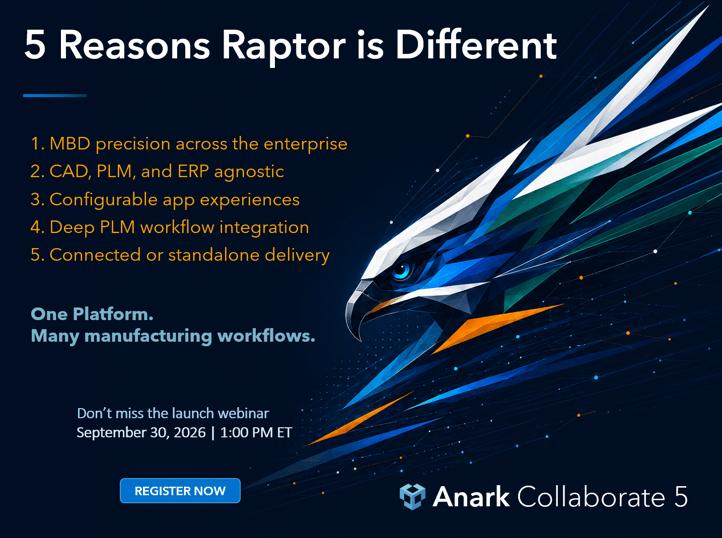
Of course, we also spent a lot of time at GPDIS talking about Anark Collaborate 5 Raptor.
What made those conversations interesting was how quickly they moved from talking about Raptor itself to talking about the different problems people are trying to solve. Some were interested in simply making complex 3D product data easier to view and share. Others wanted to talk about revision comparison, EBOM-to-MBOM comparison, First Article Inspection, QIF, supplier collaboration, or how information from different enterprise systems can be brought together around the product.
That is really the point of Raptor. It is not about one specific workflow. It provides a common model-based collaboration platform that can be applied across a wide range of engineering, manufacturing, quality, and supplier use cases.
We showed and discussed how Raptor can help teams visually understand what changed between product revisions, compare engineering and manufacturing BOM structures, bring QIF inspection results together with the 3D product definition for First Article Inspection, and make complex product information available to people who do not live every day inside CAD and PLM systems.
Those conversations also reinforced how different the needs can be from one organization or even one department to another. The common requirement is access to trusted product information in a form people can understand, interact with, and use to get their work done.
Continuing the Conversations
GPDIS 2026 reinforced something Anark has believed for years: the future of the digital enterprise is not about replacing authoritative engineering systems. It is about extending the value of the trusted information inside those systems to everyone who needs to participate in the product lifecycle.
Standards provide the foundation. Model-based collaboration makes that information usable. And increasingly, trusted product context will provide the foundation that makes AI valuable across the engineering enterprise.
Join us for the Anark Collaborate 5 Raptor Launch Webinar on September 30 at 1PM ET to see how Raptor carries model-based product data into broader collaboration across engineering, manufacturing, quality, suppliers, and the extended enterprise.
Our mantra with Raptor is simple: Show us your use case and we can make it happen so reach out anytime and Contact Anark!