.png?width=133&height=43&name=Logo%20(4).png "Logo (8)")
In our previous post, we explored the Data Distribution Dilemma.
Modern Digital Engineering programs must deliver authoritative product definition beyond CAD and PLM environments. Engineering data must move across internal teams, suppliers, partners, regulators, and sustainment organizations. The challenge is not simply creating accurate models. It is ensuring those models can be distributed in ways that match real-world constraints.
That reality leads to a critical architectural question: If Digital Engineering data must be distributed, what kind of portability does that distribution require?
Not all distribution modes are the same. And not all portability serves the same purpose. This article clarifies the available approaches, their strengths, and where each is most appropriate.
Digital Engineering Distribution Operates in Two Modes
To optimize Digital Engineering data distribution, you first need to understand the two primary modes used across the industry today:
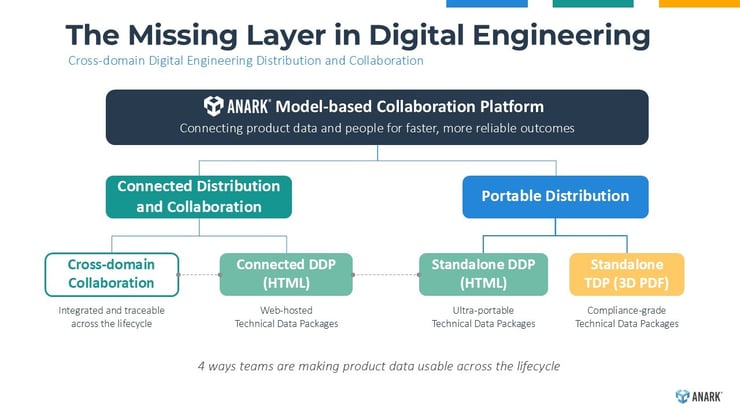
Hosted Distribution
Hosted distribution involves authoritative content accessed within a managed, system-connected environment. A familiar example is SharePoint. More specialized solutions now exist that integrate directly with an Authoritative Source of Truth (ASOT), often a PDM or PLM system.
While PLM systems are highly effective for engineering teams and their rigorous data management needs, they frequently create a collaboration gap for stakeholders outside of engineering who require simplified access and intuitive review tools. Hosted distribution bridges that gap by extending governed access beyond the core authoring system.
Portable Distribution
Portable distribution consists of self-contained, system-independent artifacts that move beyond the network. These are the Technical Data Package (TDP) files that have expanded engineering data access for more than a decade.
Portable TDP solutions range from desktop publishing tools to enterprise publishing servers integrated with CAD and PLM systems, capable of automating the production of hundreds to hundreds of thousands of TDPs per year.
Hosted and portable distribution are not competitors. They solve different problems.
Hosted distribution is ideal when collaboration can remain inside a controlled environment. It enables governed access, traceable reviews, centralized control, and structured workflows. When stakeholders share reliable connectivity and aligned system access, hosted distribution is powerful.
However, hosted distribution depends on persistent access to the environment serving the data. That assumption does not always hold.
Programs span air-gapped manufacturing facilities, segmented defense networks, supplier ecosystems with varying IT maturity, export-controlled environments, and long lifecycles in which systems evolve or are replaced. In those conditions, portability is not optional.
It is required.
Portable Distribution Is Not One-Size-Fits-All
If Digital Engineering data must move beyond the network, portable distribution should align with established product data and lifecycle management practices.
In some organizations, this requires seamless integration with PLM and ERP lifecycle states and workflows, supporting formal engineering data release and contract deliverable generation. In others, portable TDPs are generated on demand to provide extended stakeholders with timely access to consumable engineering data.
Regardless of the use case, Portable Distribution includes two complementary formats:
3D PDF
3D PDF Technical Data Packages (TDP) provide compliance-grade portability widely accepted for contractual and long-lifecycle deliverables.
Standalone HTML
Standalone HTML Technical Data Packages (TDP) provide ultra-portable delivery, browser-native performance, and frictionless access across devices and ecosystems.
Understanding the distinction between these forms of portability is essential.
Compliance-Grade Portability: The Role of 3D PDF
3D PDF has long delivered portable access to model-based product definition in regulated and defense programs. It is trusted as a compliance-grade format because it:
- Supports contractual and regulatory requirements
- Provides self-contained, archivable deliverables
- Preserves authoritative product definition independent of CAD or PLM access
- Is widely recognized across procurement and oversight environments
Compliance-grade portability centers on institutional acceptance and lifecycle stability. It ensures that authoritative engineering content can be formally distributed, archived, and referenced years or decades later.
For many programs, this level of portability is foundational. But distribution requirements extend beyond compliance alone.
Ultra-Portability: Expanding Reach with Standalone HTML
Modern Digital Engineering ecosystems are increasingly heterogeneous. Stakeholders use different devices, operating systems, and access models. Performance expectations are higher. Distribution must be faster and more certain.
Standalone HTML Technical Data Packages extend Portable Distribution into ultra-portable delivery. Ultra-portable delivery means:
- Opens on virtually any device with a modern web browser
- Requires no proprietary viewer installation
- Delivers high performance, even with large assemblies
- Enables frictionless distribution across diverse environments
- Removes uncertainty about whether a recipient can access the content
Ultra-portability prioritizes universal accessibility and performance certainty. When a package is sent, it can be opened and used immediately.
This does not replace compliance-grade portability. It expands the portable category to meet modern distribution realities.
Together, 3D PDF and standalone HTML create a layered portability strategy supporting both formal program requirements and frictionless operational distribution.
Which Type of Portability Is Right for Which Use Case?
The question is not whether portability matters. It is which type of portability best supports a specific distribution scenario.
Hosted Distribution is appropriate when:
- Stakeholders operate within a shared, governed environment
- Real-time collaboration and markup workflows are required
- Persistent system connectivity can be assumed
Compliance-grade Portable Distribution is appropriate when:
- Formal contractual deliverables are required
- Regulatory alignment is necessary
- File-based stability and archival integrity are priorities
- Institutional acceptance is critical
Ultra-portable Distribution is appropriate when:
- Recipients operate across diverse devices and ecosystems
- Viewer installation cannot be guaranteed
- Fast performance with large assemblies is required
- Distribution friction must be minimized
Optimizing Digital Engineering data distribution means selecting the right mode for the right context. Hosted collaboration ensures governed interaction. Compliance-grade portability ensures contractual durability. Ultra-portability ensures universal accessibility. All three play a critical role in delivering the right data to the right people at the right time in the right format.
Portability Makes Digital Engineering Data Distribution Resilient
The Data Distribution Dilemma is not solved by expanding access alone. It is solved by designing distribution architectures that remain resilient beyond system boundaries.
When Digital Engineering depends entirely on hosted environments, distribution becomes conditional. When authoritative artifacts can move independently of persistent system access, distribution becomes versatile and durable.
As Digital Engineering expands across mechanical, electrical, software, requirements, simulation, and inspection domains, distribution complexity increases. Multi-domain initiatives such as Digital Data Packages (DDP) reflect this trajectory.
That future depends on an array of portability options to ensure critical Digital Engineering data reaches its destination successfully. Authoritative engineering content must move securely and coherently beyond the systems that created it without breaking the digital thread.
One Publishing Platform. Every Distribution Mode.
Optimizing Digital Engineering distribution does not require separate toolchains for each mode.
Hosted distribution, compliance-grade portability, and ultra-portable delivery can all be generated from a single publishing platform integrated with your authoritative source systems. This enables these distribution modes to work together to support governed collaboration, contractual compliance, and frictionless accessibility without compromising control.
This versatile approach makes Digital Engineering data distribution scalable and resilient in the real world.
Start the Conversation
If you are rethinking how your organization distributes authoritative engineering data, we would welcome the conversation.
Contact Anark to explore how a unified publishing and collaboration platform can support every Digital Engineering distribution mode from a single, integrated source of truth.


